Deal-by-Deal Investing vs Blind-Pool Funds: Understanding Control, Transparency, Speed and Investor Tradeoffs

Private real estate investing has expanded rapidly in recent years. More investors are moving beyond traditional stocks and bonds and looking toward alternative assets that can offer income, diversification and long-term growth. Real estate funds have become one of the most popular entry points because they allow investors to participate in large projects that would otherwise require significant capital and operational expertise.
However, not all real estate funds operate the same way.
Two common structures often come up when investors begin exploring private real estate opportunities: deal-by-deal investing and blind-pool funds. Each approach offers its own advantages, challenges and level of investor involvement.
For some investors, control and visibility into each property matters most. For others, convenience and speed of deployment are more appealing.
Understanding the differences between these two structures can help investors align their capital with the strategy that best fits their goals, risk tolerance and investment style.
This guide explains how deal-by-deal investing and blind-pool funds work, highlights the key tradeoffs and explores how investors evaluate these options when allocating capital.
What Is Deal-by-Deal Investing?

Deal-by-deal investing is exactly what the name suggests. Instead of committing capital to a fund that invests in multiple properties, investors evaluate and choose individual real estate deals one at a time.
Each project is typically presented as a separate opportunity with its own investment summary, financial projections, timeline and business plan. Investors can review the details and decide whether to participate in that specific deal.
This structure gives investors greater flexibility because they can select projects that match their preferences.
For example, an investor may choose to participate in:
- A new construction development
- A value-add renovation project
- A stabilized rental property
- A commercial repositioning opportunity
Rather than committing to a large blind investment, investors allocate capital only when they feel confident in the opportunity.
Key Characteristics of Deal-by-Deal Investing
Several traits define this investment approach:
1. Investor Choice
Investors evaluate each opportunity independently and decide whether to participate.
2. Project-Level Transparency
Every deal usually includes detailed information about the property, the business plan and expected returns.
3. Flexible Capital Allocation
Investors can diversify across deals at their own pace.
4. Direct Deal Understanding
Investors gain insight into how individual projects operate and perform.
For many investors, the ability to review and approve each opportunity creates a sense of involvement that is not always present in larger pooled structures.
What Is a Blind-Pool Fund?

A blind-pool fund operates differently.
In this structure, investors commit capital to a fund before specific properties are identified or acquired. The fund manager then uses that capital to find, acquire and manage investments over a defined period of time.
Investors rely heavily on the experience, track record and strategy of the fund sponsor because the exact deals are not known at the time the investment is made.
Blind-pool funds are commonly used in private equity and real estate investment firms because they allow managers to move quickly when opportunities appear in the market.
Key Characteristics of Blind-Pool Funds
Blind-pool funds typically include the following elements:
1. Upfront Capital Commitment
Investors commit capital to the fund before individual properties are acquired.
2. Manager-Led Deal Selection
The fund sponsor identifies and executes investment opportunities.
3. Portfolio Diversification
The fund usually acquires multiple assets within a defined strategy.
4. Defined Investment Period
Many funds have a structured lifecycle that includes acquisition, management, and eventual exit.
This structure allows professional managers to build a portfolio of properties without needing investor approval for every single acquisition.
Control: Who Makes the Investment Decisions?

One of the biggest differences between the two models is who controls the investment decisions.
Deal-by-Deal Control
Deal-by-deal investing offers investors the ability to decide whether each opportunity fits their goals.
Investors can review:
- Property location and type
- Market dynamics
- Development or renovation plans
- Expected timeline
- Projected returns
If a deal does not meet their expectations, they simply pass and wait for the next opportunity.
This level of control can appeal to investors who prefer a more hands-on approach to allocating capital.
Blind-Pool Control
Blind-pool funds operate with a different philosophy.
Investors place their trust in the fund manager's strategy and decision-making process. Once capital is committed, the manager decides which properties to acquire and when.
For investors who prefer a more passive investment experience, this structure can be attractive. It removes the need to evaluate every deal individually.
However, it also means investors must be comfortable with the sponsor making all acquisition decisions.
Transparency: How Much Visibility Do Investors Have?

Transparency plays a major role in how investors perceive risk and trust in a fund structure.
Transparency in Deal-by-Deal Investing
Because each investment is presented separately, deal-by-deal structures often provide significant information upfront.
Investors typically receive:
- Detailed offering memorandums
- Financial projections
- Market research
- Construction or renovation timelines
- Exit strategies
This transparency allows investors to fully understand what they are investing in before committing capital.
Many investors appreciate this clarity because it allows them to analyze opportunities more thoroughly.
Transparency in Blind-Pool Funds
Blind-pool funds operate with a different level of visibility.
At the time of investment, investors typically know:
- The overall strategy of the fund
- Target property types
- Geographic focus or market segment
- Expected return ranges
- Investment timeline
However, the specific properties are often not identified yet.
While investors still receive reporting and updates as deals are acquired, the initial investment decision requires trust in the manager's expertise and discipline.
Speed: Which Structure Moves Faster?

Speed can be a significant factor in real estate investing because attractive opportunities often appear and disappear quickly.
Speed in Blind-Pool Funds
Blind-pool funds are typically designed for speed and efficiency.
Because capital is already committed, fund managers can move quickly when a property becomes available. This allows them to compete effectively in competitive markets where deals may close rapidly.
The ability to deploy capital without waiting for individual investor approvals is one of the biggest advantages of this structure.
Speed in Deal-by-Deal Investing
Deal-by-deal investing sometimes requires more time.
Each opportunity must be presented, reviewed and approved by investors before capital is committed. This process can slow down acquisitions compared to blind-pool funds.
However, this slower pace can also provide investors with more time to review the opportunity and ask questions before making a decision.
Risk and Diversification

Risk management is another key factor when comparing these two investment approaches.
Diversification in Blind-Pool Funds
Blind-pool funds often acquire multiple properties within a single fund.
This can create built-in diversification across:
- Asset types
- Property locations
- Investment strategies
Because capital is spread across several assets, performance may be less dependent on the outcome of any single property.
For investors seeking diversification through a single commitment, this structure can be appealing.
Diversification in Deal-by-Deal Investing
Deal-by-deal investors build diversification over time by selecting multiple projects individually.
This allows investors to:
- Choose different property types
- Participate in various strategies
- Allocate capital across multiple deals
While diversification is still possible, it requires more active decision making from the investor.
Investor Experience and Involvement

Another important difference lies in how involved investors want to be in the process.
Deal-by-Deal Investor Experience
Investors who enjoy analyzing opportunities often prefer deal-by-deal investing.
It allows them to:
- Study individual properties
- Compare opportunities
- Select projects aligned with their interests
This approach can create a more engaging investment experience for those who like to stay close to the decision-making process.
Blind-Pool Investor Experience
Blind-pool funds are often better suited for investors who want a simplified investment experience.
Once the capital commitment is made, the sponsor handles:
- Deal sourcing
- Acquisition negotiations
- Asset management
- Property operations
- Exit strategies
Investors receive updates and performance reports while remaining largely passive.
Tradeoffs Investors Should Consider
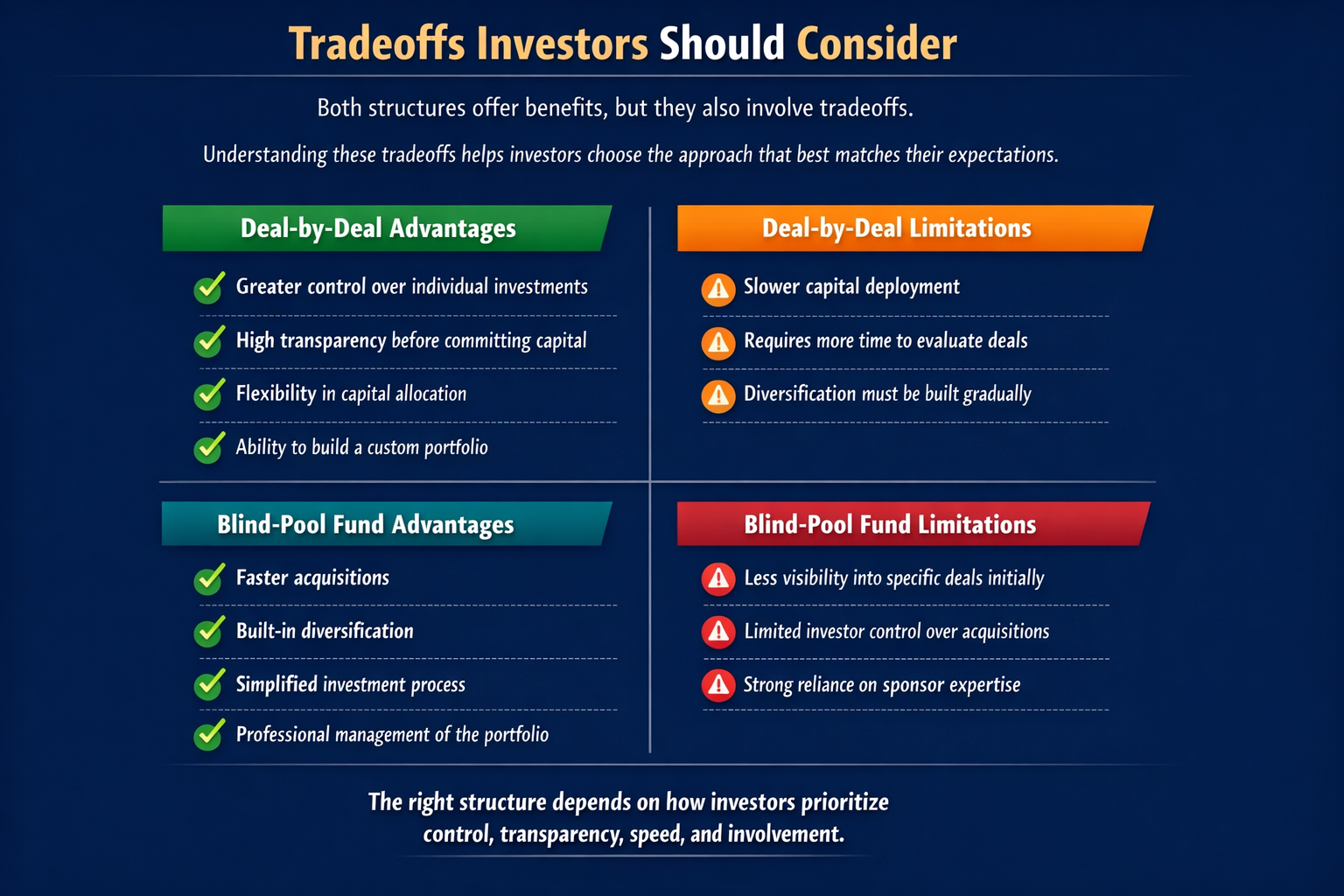
Both structures offer benefits, but they also involve tradeoffs.
Understanding these tradeoffs helps investors choose the approach that best matches their expectations.
Deal-by-Deal Advantages
- Greater control over individual investments
- High transparency before committing capital
- Flexibility in capital allocation
- Ability to build a custom portfolio
Deal-by-Deal Limitations
- Slower capital deployment
- Requires more time to evaluate deals
- Diversification must be built gradually
Blind-Pool Fund Advantages
- Faster acquisitions
- Built-in diversification
- Simplified investment process
- Professional management of the portfolio
Blind-Pool Fund Limitations
- Less visibility into specific deals initially
- Limited investor control over acquisitions
- Strong reliance on sponsor expertise
Ultimately, the right structure depends on how investors prioritize control, transparency, speed and involvement.
How Many Investors Combine Both Approaches

Interestingly, many experienced investors do not limit themselves to one structure.
Instead, they combine both approaches to balance flexibility and convenience.
For example, an investor might allocate part of their capital to a blind-pool fund for diversification and steady deployment, while also participating in select deal-by-deal opportunities that align with their personal investment preferences.
This hybrid approach can provide the best of both worlds by combining strategic portfolio management with targeted investments.
Evaluating the Sponsor Matters in Both Structures
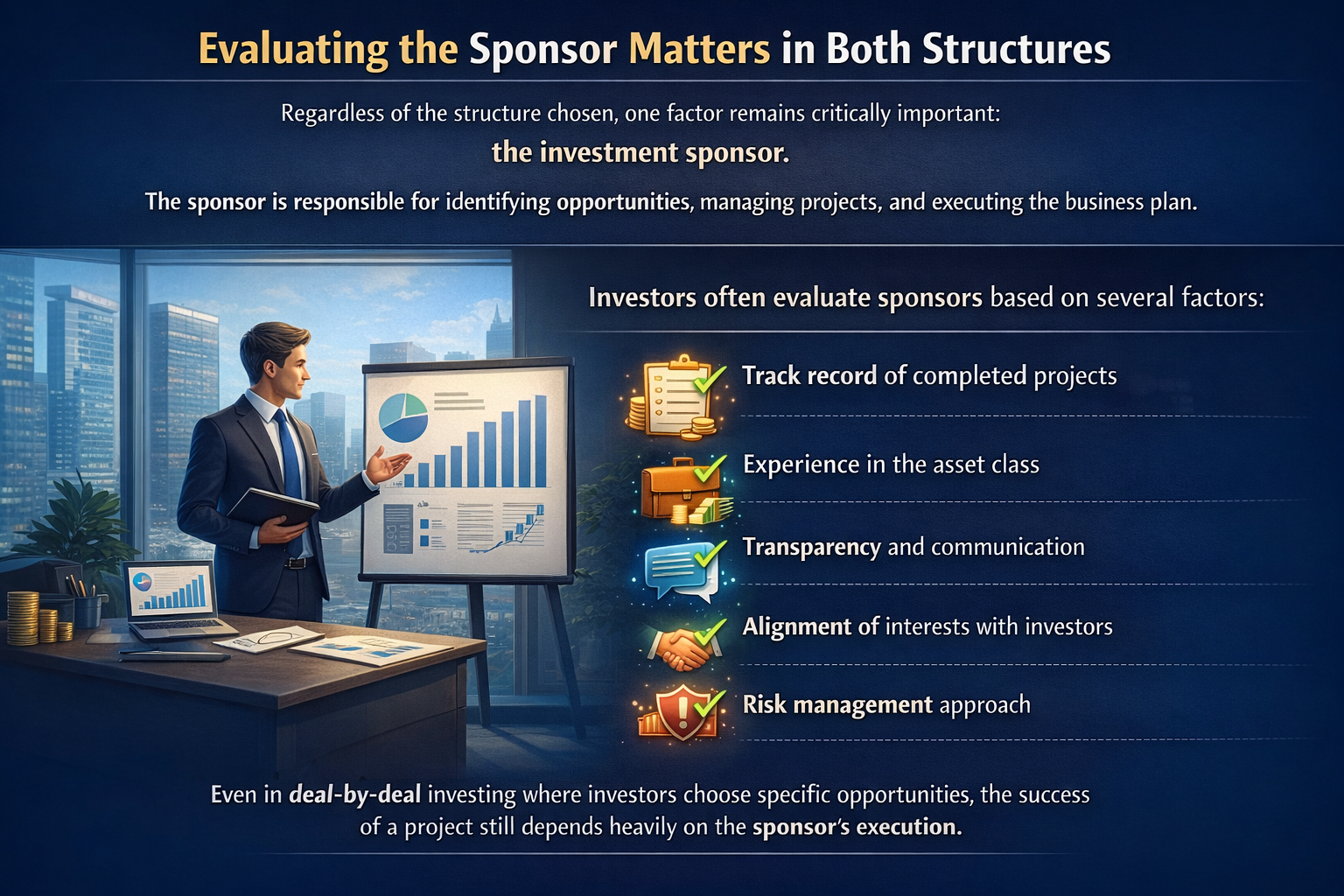
Regardless of the structure chosen, one factor remains critically important: the investment sponsor.
The sponsor is responsible for identifying opportunities, managing projects and executing the business plan.
Investors often evaluate sponsors based on several factors:
- Track record of completed projects
- Experience in the asset class
- Transparency and communication
- Alignment of interests with investors
- Risk management approach
Even in deal-by-deal investing where investors choose specific opportunities, the success of a project still depends heavily on the sponsor's execution.
Final Thoughts
Private real estate investing offers a wide range of structures designed to meet different investor preferences. Deal-by-deal investing and blind-pool funds represent two widely used models that balance control, transparency and efficiency in different ways.
Deal-by-deal opportunities provide investors with the ability to evaluate each project individually and decide exactly where their capital is deployed. This approach offers greater visibility and flexibility but requires more involvement in the decision-making process.
Blind-pool funds, on the other hand, allow investors to commit capital to a professional manager who builds a diversified portfolio of assets over time. This structure can offer speed and simplicity but relies heavily on the expertise and discipline of the sponsor.
Understanding these differences helps investors approach private real estate with greater clarity and confidence.
As the private investment landscape continues to evolve, firms such as Prawdzik Capitals continue to explore opportunities that align strategic real estate development with investor-focused transparency and long-term value creation.
For investors evaluating private real estate opportunities, recognizing the structure behind each investment is just as important as understanding the property itself.