Evergreen Funds vs. Closed-End Funds: Liquidity, Reinvestment, Timing and How to Choose the Right Structure

In today’s investment environment, structure matters just as much as strategy. Markets are moving faster. Capital cycles are shorter. Investors are demanding flexibility without sacrificing performance. At the same time, fund managers are designing vehicles that better align with long term capital formation and disciplined deployment.
Two of the most discussed structures in private markets are evergreen funds and closed-end funds. While both can offer access to income generating investments and growth opportunities, the way they handle liquidity, reinvestment and timing can dramatically impact outcomes.
Understanding the difference between evergreen funds and closed-end funds is not just technical knowledge. It directly affects how and when you receive returns, how long your capital is committed and how opportunities are pursued inside the fund.
If you are evaluating private investment options, this guide will walk you through liquidity mechanics, reinvestment strategies, capital timing and the type of investor each structure typically serves best.
What Is an Evergreen Fund?

An evergreen fund is an open ended investment vehicle with no fixed termination date. Investors can typically subscribe on a recurring basis and may request redemptions according to predefined liquidity terms.
Instead of raising capital for a set period and winding down after asset sales, evergreen funds are designed to operate continuously. New capital flows in. Investments are made. Distributions occur. Assets are reinvested. The fund does not have a hard stop date.
Core Characteristics of Evergreen Funds
- No predetermined liquidation date
- Continuous capital raising
- Periodic redemption options, subject to fund rules
- Reinvestment of proceeds into new opportunities
- Ongoing asset management cycle
Evergreen funds are often structured to provide smoother income streams and more flexibility for investors who prefer ongoing exposure rather than a fixed commitment window.
What Is a Closed-End Fund?

A closed-end fund is a vehicle with a defined lifespan, typically ranging from five to ten years or longer depending on strategy. Investors commit capital upfront and the manager deploys it during a defined investment period.
After investments mature, assets are sold, profits are distributed and the fund is wound down.
Core Characteristics of Closed-End Funds
- Fixed investment period
- Defined exit timeline
- Capital commitments rather than ongoing subscriptions
- Limited or no redemption during fund life
- Clear harvesting phase
Closed-end structures are common in private equity, development projects, and opportunistic strategies that require time to execute and exit.
Liquidity: Access to Your Capital

Liquidity is one of the biggest differences between evergreen and closed-end funds.
Evergreen Fund Liquidity
Evergreen funds often offer periodic redemption windows. This might be quarterly or annually. However, redemptions are typically subject to:
- Notice requirements
- Minimum holding periods
- Redemption caps if demand exceeds availability
- Possible lockup periods
This means evergreen funds are not daily liquid like public stocks. However, they generally provide more flexibility than closed-end funds.
For investors seeking partial access to capital without waiting for a full fund liquidation, evergreen structures can offer a middle ground.
Closed-End Fund Liquidity
Closed-end funds are designed with illiquidity in mind. When you commit capital, you are agreeing to keep it invested for the duration of the fund.
Liquidity typically occurs only when:
- Assets are sold
- The fund distributes proceeds
- The fund fully exits
There is usually no redemption option during the life of the fund. This structure allows managers to execute longer term strategies without worrying about sudden capital withdrawals.
Which Liquidity Model Fits You?
Evergreen funds may suit investors who:
- Want some redemption flexibility
- Value steady capital recycling
- Prefer ongoing exposure
Closed-end funds may suit investors who:
- Can commit capital for multiple years
- Prioritize disciplined asset lifecycle execution
- Seek defined entry and exit cycles
Liquidity is not simply about convenience. It shapes the type of investments a fund can pursue and how aggressively it can deploy capital.
Reinvestment Strategy: Compounding vs Distribution Cycles

How profits are handled is another defining difference.
Reinvestment in Evergreen Funds
In evergreen structures, proceeds from asset sales are typically reinvested into new opportunities. This creates a compounding effect over time.
Benefits of reinvestment include:
- Continuous capital deployment
- Reduced idle cash drag
- Potential smoothing of returns
- Ability to capture new market cycles
This model can benefit investors who want long term exposure without manually redeploying distributed capital.
However, it also means you may not receive large lump sum distributions unless you redeem.
Reinvestment in Closed-End Funds
Closed-end funds often distribute realized gains back to investors after asset sales. While some reinvestment may occur during the investment period, there is usually a structured harvesting phase.
Advantages include:
- Clear return of capital
- Defined profit realization
- Transparency around exit timing
This approach can appeal to investors who want predictable distribution cycles and visibility into when capital is returned.
Timing: Market Cycles and Deployment Strategy

Timing plays a major role in private investment performance. Fund structure influences how managers respond to market conditions.
Evergreen Funds and Timing
Because evergreen funds continuously raise capital, they may invest across multiple market cycles. This can provide diversification across time.
Benefits include:
- Reduced exposure to single entry point risk
- Opportunity to deploy capital in changing environments
- Ongoing asset rotation
However, continuous deployment requires disciplined underwriting to avoid investing simply because capital is available.
Closed-End Funds and Timing
Closed-end funds raise capital during a specific fundraising period and deploy it over a defined investment window.
This can create:
- Concentrated exposure to a specific market cycle
- Strong alignment between strategy and timing
- Clear capital allocation plan
Managers can focus entirely on optimizing exits rather than managing subscriptions and redemptions.
If you believe market conditions are particularly attractive today, a closed-end fund may allow for concentrated exposure to that window.
If you prefer diversification across cycles, an evergreen structure may provide broader timing flexibility.
Cash Flow Expectations

Investors often evaluate funds based on cash flow profiles.
Evergreen Cash Flow
Evergreen funds may provide:
- Regular income distributions
- Smoother return patterns
- Ongoing yield focused strategies
This can be appealing for investors seeking income generating investments rather than large future payouts.
Closed-End Cash Flow
Closed-end funds often show:
- Limited early distributions
- Larger payouts during the harvesting phase
- Back loaded returns
This is common in development or value add strategies where returns materialize at exit.
Understanding your personal cash flow needs is critical before choosing a structure.
Risk Considerations

Structure also influences risk.
Evergreen Risk Profile
Because evergreen funds continuously reinvest, investors are exposed to evolving market conditions indefinitely.
Pros:
- Diversification across time
- Continuous asset refresh
Cons:
- No automatic liquidation
- Ongoing exposure unless redeemed
Closed-End Risk Profile
Closed-end funds typically concentrate risk within a defined timeline.
Pros:
- Clear beginning and end
- Forced exit discipline
Cons:
- Timing risk if entry cycle is unfavorable
- Illiquidity for the fund duration
Risk tolerance should align with structural design.
Alignment of Interests

Both structures can align manager and investor interests but they do so differently.
Closed-end funds often include:
- Performance based incentive structures
- Carried interest tied to realized gains
- Defined profit sharing waterfalls
Evergreen funds may emphasize:
- Long term asset growth
- Stable income generation
- Net asset value based performance
Investors should review fee structures carefully in either case. Compensation mechanics influence behavior.
Operational Complexity

Evergreen funds require:
- Ongoing valuation processes
- Redemption management
- Continuous reporting
Closed-end funds require:
- Capital call administration
- Exit coordination
- Final wind down procedures
Neither is inherently superior. The operational model simply supports different strategic goals.
When Evergreen Funds Make Sense

Evergreen funds may be a strong fit if you:
- Want flexibility in entering and exiting
- Prefer long term capital compounding
- Value smoother income streams
- Seek diversification across investment cycles
They are often attractive to investors building long horizon portfolios who want exposure without committing to a fixed end date.
When Closed-End Funds Make Sense

Closed-end funds may be ideal if you:
- Are comfortable with multi year commitments
- Want defined capital return timelines
- Prefer structured harvesting phases
- Believe current market conditions present a compelling entry point
They are often used for development, repositioning strategies, and opportunistic capital deployment.
Comparing Evergreen Funds vs Closed-End Funds at a Glance
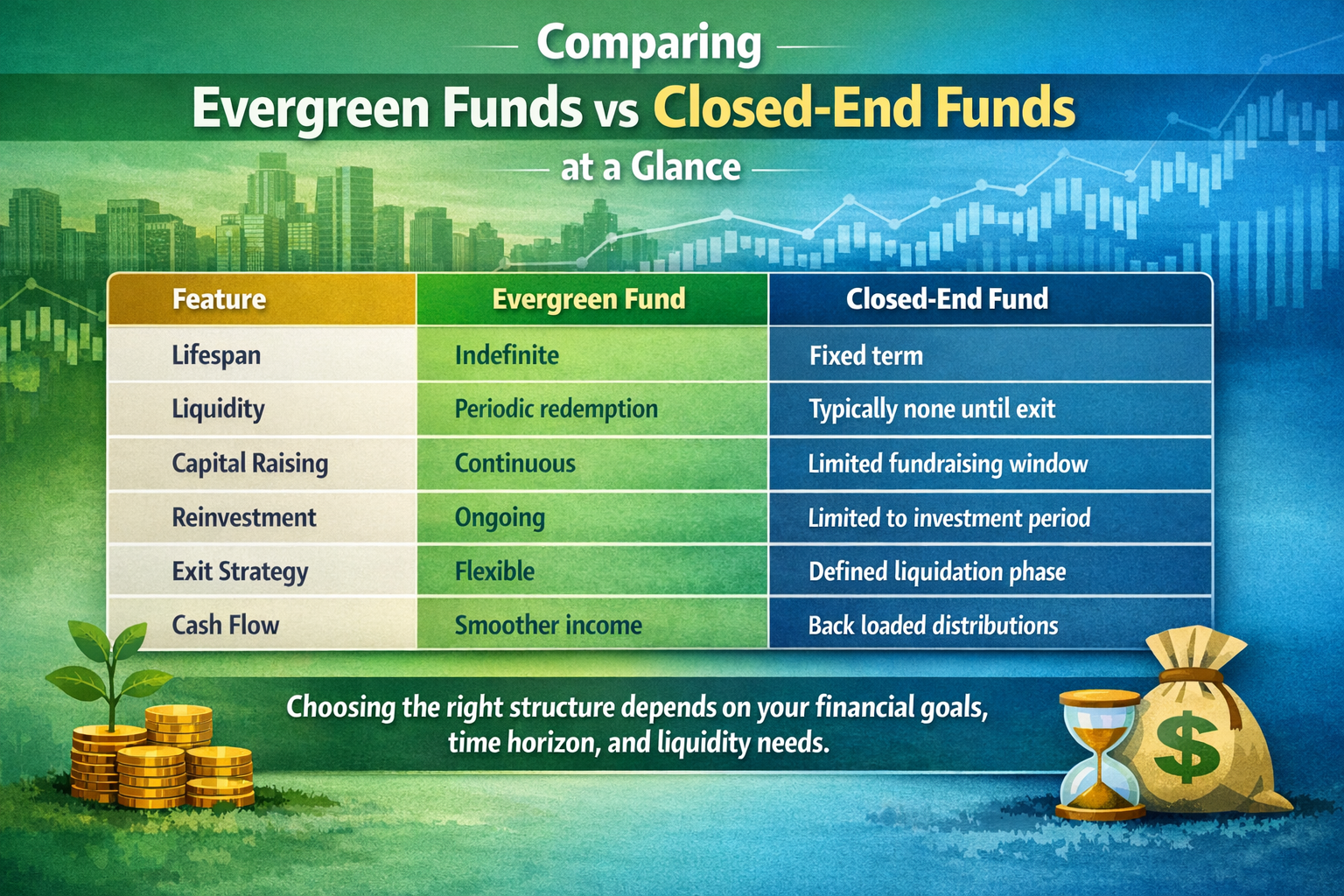
This side by side comparison highlights the structural differences between evergreen funds and closed-end funds in a clear and practical way.
Evergreen funds are designed for continuity, offering an indefinite lifespan, periodic redemption options, continuous capital raising and ongoing reinvestment. This structure often supports smoother income distribution and long term capital compounding.
In contrast, closed-end funds operate within a fixed term, raise capital during a limited window and typically do not provide liquidity until assets are exited. Their reinvestment period is defined and cash flow is often back loaded, with larger distributions occurring during the liquidation phase.
While both structures can be effective, the right choice ultimately depends on your financial goals, investment timeline and need for liquidity.
Questions to Ask Before Choosing
- How long can I commit this capital?
- Do I need predictable income or long term growth?
- Am I comfortable with limited liquidity?
- Do I prefer defined exit cycles?
- How important is reinvestment and compounding?
Answering these questions helps clarify which structure aligns with your broader investment strategy.
Final Thoughts: Structure Should Match Strategy
Evergreen funds and closed-end funds are not competing products. They are tools designed for different objectives.
Evergreen funds emphasize flexibility, reinvestment and long term continuity. Closed-end funds emphasize defined timelines, structured exits and concentrated deployment.
The key is not choosing the trendier structure. The key is choosing the one that aligns with your capital goals, liquidity preferences and risk tolerance.
At Prawdzik Capitals, thoughtful fund design is central to creating opportunities that match investor objectives. Whether structured for disciplined exit strategies or ongoing capital growth, the focus remains on transparency, alignment and long term value creation.
In private markets, structure is strategy. And understanding the difference between evergreen and closed-end funds can help you make smarter, more confident investment decisions.